Governance
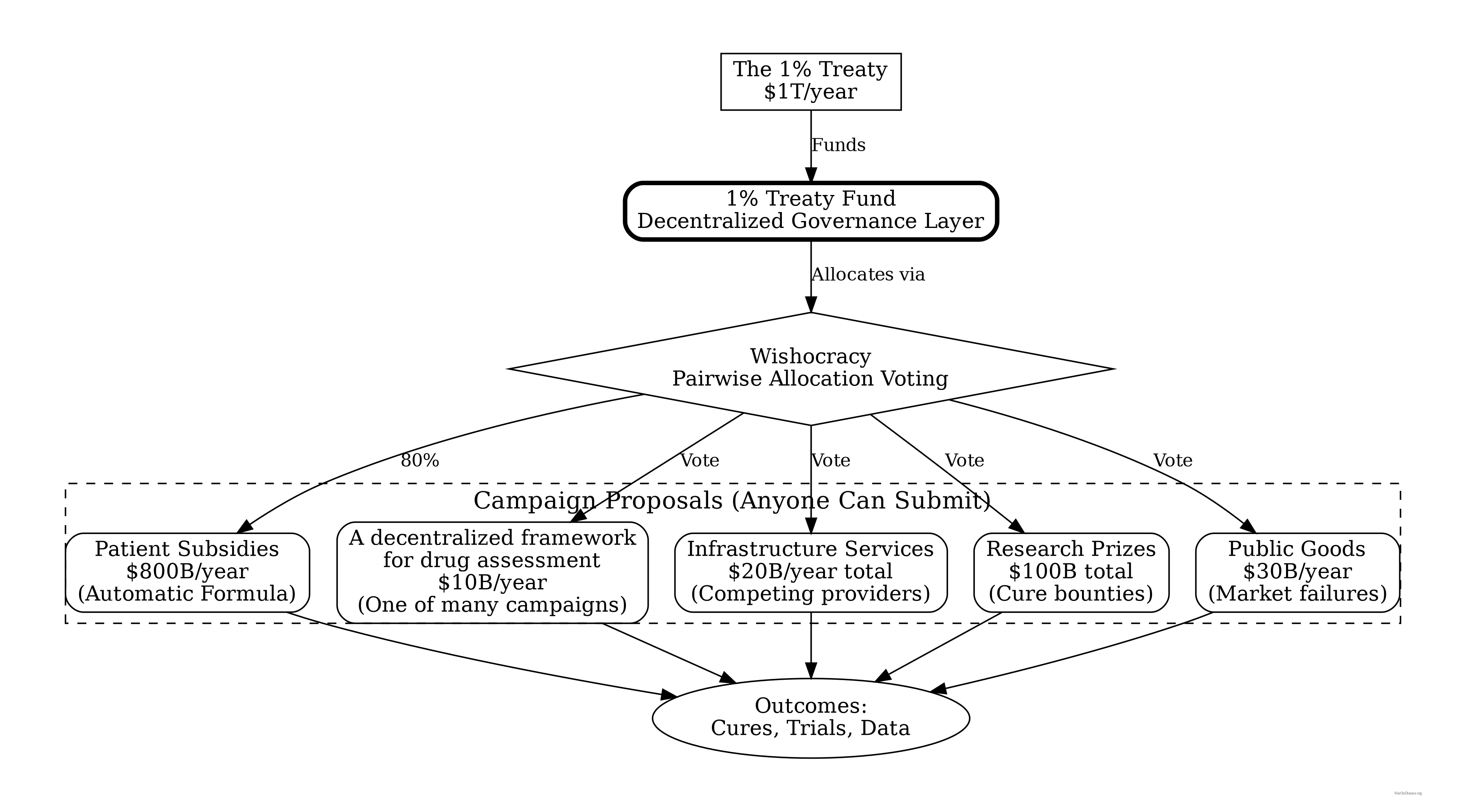
How the People Who Pay Get to Vote - The governance model for the DIH is Wishocracy, a decentralized protocol for creating a global, semi-autonomous ‘to-do list for humanity’ governed by the people who use it.
Abstract
By redirecting 1% of global military spending to hyper-efficient pragmatic clinical trials, humanity can achieve 514 years of medical research in 20 years and shift the cure of every disease forward by 8.2 years, saving 416 million lives and generating $1.2 quadrillion in value.
Keywords
war-on-disease, 1-percent-treaty, medical-research, public-health, peace-dividend, decentralized-trials, dfda, dih, victory-bonds, health-economics, cost-benefit-analysis, clinical-trials, drug-development, regulatory-reform, military-spending, peace-economics, decentralized-governance, wishocracy, blockchain-governance, impact-investing
Your decentralized institutes of health (DIH) is a decentralized crowdfunding platform that serves as the single governance layer for all health research funding.
It functions like Kickstarter meets the NIH, but without corruption or bureaucracy - governed by Wishocracy, a pairwise allocation voting system that lets 8 billion people collectively decide how to spend $27.2B annually.
DIH Architecture: Single Governance Layer
Your decentralized institutes of health (DIH) handles ALL budgeting decisions:
- Governs the allocation of the 1% Treaty Fund treasury
- Accepts campaign proposals from anyone
- Uses Wishocracy to allocate funds across competing campaigns
- No CEO, no board, governed by transparent code
Clean Separation: Governance vs Platform
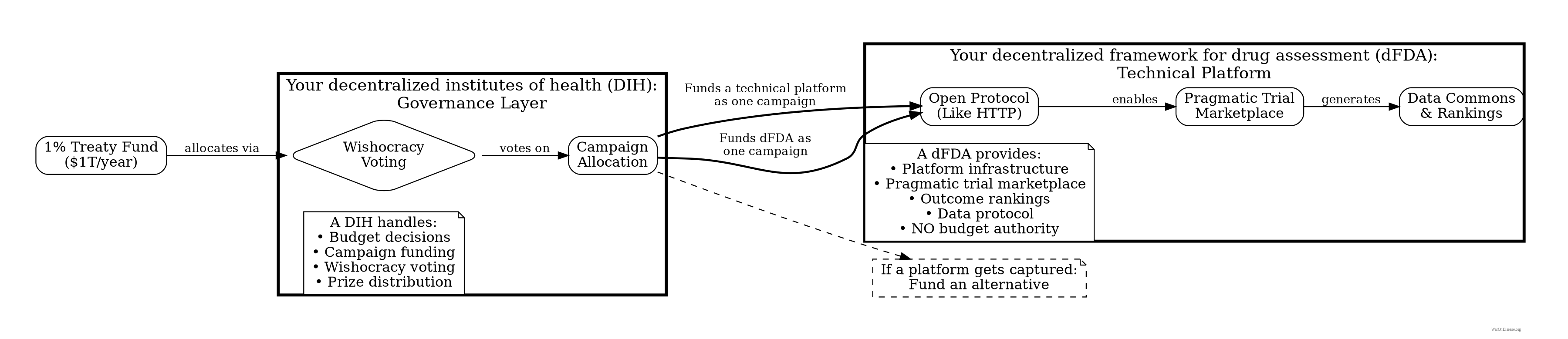
Your decentralized institutes of health (Governance Layer)
- Handles all budget allocation
- Wishocracy voting on campaigns
- Treasury governance
- Prize distribution
Your decentralized framework for drug assessment (dFDA)
- Pure technical infrastructure
- NO budget authority
- Is funded by the 1% Treaty Fund (as directed by DIH governance)
- If captured → fund an alternative platform instead
This prevents the “new FDA” problem: a decentralized framework for drug assessment can’t become a bureaucratic bottleneck because it has no independent funding - it’s just one campaign competing with others for 1% Treaty Fund funds.
How Budget Allocation Works
Your decentralized institutes of health (DIH) network uses Wishocracy - a pairwise voting system - to allocate funds across competing campaign proposals.
See Wishocracy for detailed explanation of how pairwise allocation works.
What Gets Funded: Market Failures Only
Since the marketplace enabled by a decentralized framework for drug assessment (dFDA) handles most research allocation automatically (patients choose trials → funding flows there), the 1% Treaty Fund primarily funds market failures - things the marketplace can’t handle:
Infrastructure (Platform Must Exist First)
- Development and operations for a decentralized framework for drug assessment (~$10B/year)
- Competing alternative implementations of a decentralized drug assessment framework
- Data commons infrastructure (storage, processing)
- Security audits and fraud detection systems
True Public Goods (No Revenue Model)
- Patient trial participation subsidies (~$800B/year, automatic)
- Negative results publishing incentives (no revenue from failures)
- Basic research with no patient application yet (can’t be trials)
- Replication studies (unglamorous but critical)
Why This is Minimal: The marketplace created by a decentralized framework for drug assessment eliminates most traditional research funding needs. Companies register treatments → Patients join trials → Revenue flows → Research happens. Your decentralized institutes of health only needs to direct the 1% Treaty Fund to cover what the marketplace truly can’t handle.
Dive Deeper into the Governance Model
- Wishocracy (RAPPA) Governance Model: The original whitepaper on the pairwise preference allocation system used for decentralized budget decisions.
- DIH On-Chain & AI Architecture: The technical blueprint for the smart contracts, AI agents, and on-chain modules that power a decentralized institutes of health network. (Coming Soon)
Security & Anti-Corruption: Building Uncorruptible Institutions
The Challenge: A $27.2B treasury is a massive target for hackers, fraudsters, and corrupt actors.
The Multi-Layered Defense
Nobody’s in Charge (And That’s the Point)
Other organizations that manage billions of dollars this way already exist and work fine.
Turns out you don’t need a CEO when you have math.
- Every VICTORY Incentive Alignment Bond holder directly controls treasury through on-chain voting (MakerDAO/Uniswap model)
- No human signers = no kidnapping, corruption, or coercion targets
- Smart contracts automatically execute community decisions after 24-72h timelocks
- Battle-tested approach managing billions in existing DAOs
AI-Powered Fraud Detection
- Fraud Agent: real-time anomaly detection, duplication monitoring, collusion identification, sybil detection
- Safety Oracle: incident severity scoring with automatic payout holds for affected interventions
- Manual review queue for flagged actions with whistleblower bounty rewards
- Identity Oracle: verifies affiliations and conflicts, prevents unauthorized access
Complete Transparency & Auditability
- All treasury addresses published with real-time public dashboards
- Immutable transaction logs with standardized disbursement tags
- Annual smart contract audits and semiannual operational audits with published reports
- Hash-committed invoices and budgets for full accountability
Recovery & Response Mechanisms
- Clawbacks for data falsification or trial misconduct
- Emergency pause capabilities triggered by incident signals
- Progressive unpause policies tied to remediation completion
- Guardian modules for pausing non-critical functions under defined conditions
Beyond Medical Research: A Template for Uncorruptible Governance
This isn’t just about protecting funding for pragmatic clinical trials and other public health goods – it’s an experiment in demonstrating a new model for uncorruptible, transparent governance of public goods.
Using proven DAO models that already manage billions (MakerDAO, Uniswap, Aave), you demonstrate that $27.2B can be managed with:
- Zero human targets for violence, kidnapping, or corruption
- True community control through direct token holder governance
- Complete transparency with all decisions and executions on-chain
- Automated efficiency eliminating bureaucratic waste and political favoritism
What Else This Could Fix
Once you prove you can run a $27.2B treasury without anyone stealing from it, you can do the same thing for schools, roads, or anything else the government currently screws up.
- Education: Pay teachers based on whether kids actually learn things
- Infrastructure: Fund roads that don’t immediately fall apart
- Environment: Pay for actual carbon reduction, not paperwork
- Social Services: Get help to people who need it without 47 forms
The End State: Replace corrupt, inefficient bureaucracies with transparent, automated, outcome-driven institutions that actually work and can’t be bribed.
The 1% Treaty Fund becomes the prototype for a new era of public governance - one that eliminates human corruption points entirely while delivering measurable results.
This experiment could usher in a new era of peace, prosperity, and abundance by proving that large-scale public goods can be managed through true decentralization without any centralized control points.
Reuse
Copyright
© 2025 Mike P. Sinn