The Untapped Therapeutic Frontier
war-on-disease, 1-percent-treaty, medical-research, public-health, peace-dividend, decentralized-trials, dfda, dih, victory-bonds, health-economics, cost-benefit-analysis, clinical-trials, drug-development, regulatory-reform, military-spending, peace-economics, decentralized-governance, wishocracy, blockchain-governance, impact-investing
The Untapped Therapeutic Frontier
Or: You’re Standing in the Parking Lot of Disney World
You think you’ve explored medicine. In reality, you’re standing in the parking lot of Disney World bragging about how fun the pavement is. You’ve taken pictures of the asphalt. You’ve written dissertations about the parking stripes. You’ve never gone inside.
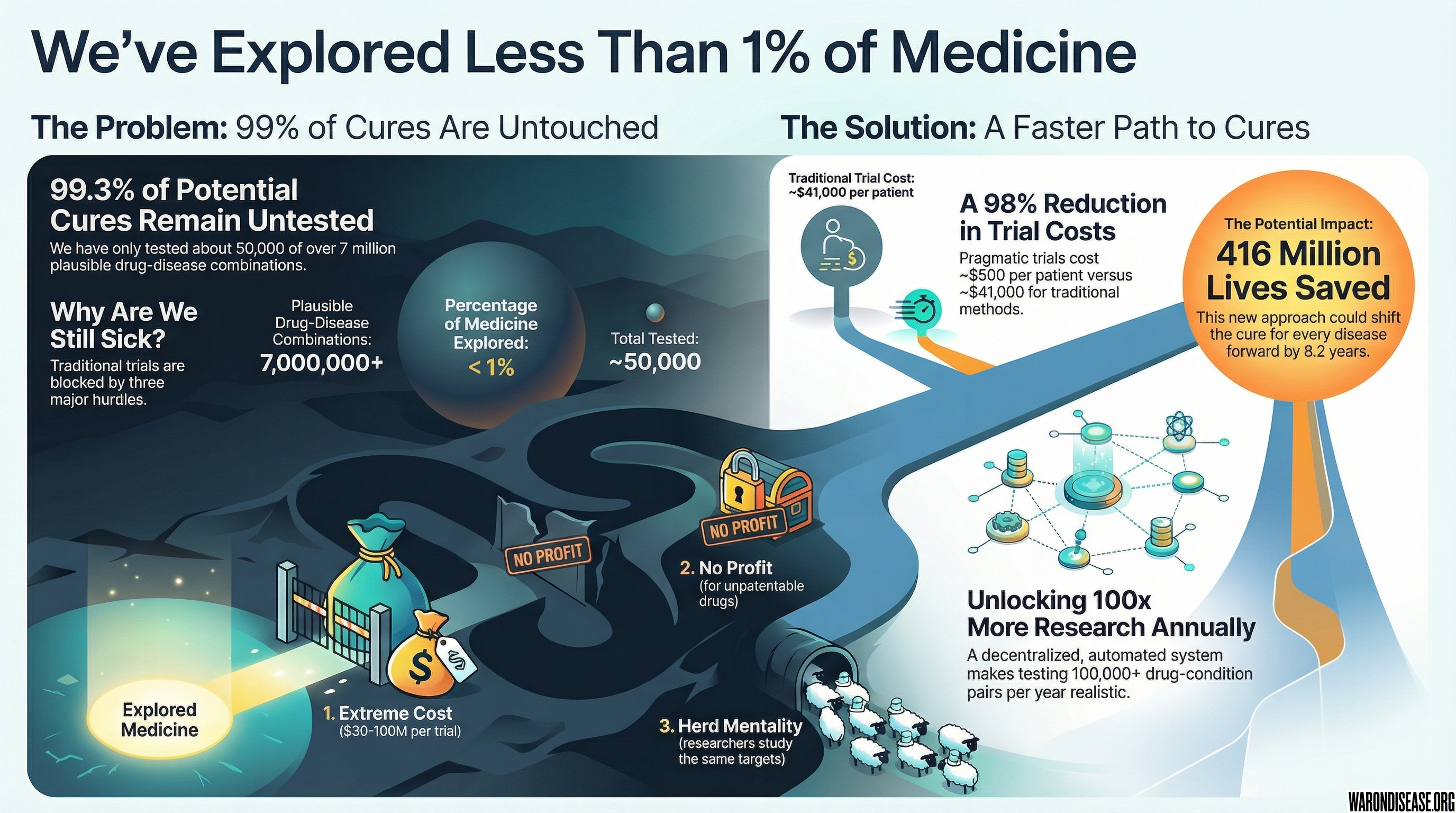
After a century of pharmacology, most beneficial effects of molecules on diseases remain unexplored. Not because biology is constrained. Because clinical trials are slow, expensive, and run by people who think “urgency” is a type of perfume.
Here’s some math. Don’t worry, it’s painful but brief.
Your Tiny Sandbox
Here is everything humanity considers “medicine” after 5,000 years of civilization:
- Prescriptions: 20.0k products approved in the U.S. Sounds impressive until you realize most are just “Tylenol, but blue.”
- Unique Ingredients: These products contain only 1.65k unique active ingredients. That’s fewer ingredients than a decent French bakery uses.
- Investigational Drugs: Pipeline analyses suggest 7.50k compounds have passed Phase I globally.
- Safe Stuff: The FDA GRAS list contains 635 substances.
Total unique compounds humanity knows are safe-ish: 9.50k.
That’s it. That’s your entire medicine cabinet after five millennia.
The Target List (Ways Your Body Breaks)
The Math You’re Ignoring
Take your 9.50k safe compounds. Multiply by 1.00k diseases. This gives you the “Combinatorial Space,” which is fancy talk for “stuff you could test tomorrow if you weren’t busy filling out forms.”
9.50k compounds × 1.00k diseases = 9.50M plausible drug-condition combinations.
What You’ve Actually Tested
- Approved uses: 1.75k unique approved drug-disease pairings.
- Repurposed uses: 30% of drugs gain at least one new indication after initial approval.
- Failed trials: Let’s be generous and say you tested 10 times as many things that failed.
Total tested: 32.5k relationships.
The Scorecard
32.5k tested / 9.50M possibilities = 0.342%
Humanity has explored less than 1% of the theoretically testable drug-disease space.
You are missing 99.7% of the picture.
It’s like reading the first page of War and Peace and writing a book report called “It’s About a Party.” Technically accurate. Cosmically insufficient.
Is The Untested Stuff Useful?
You might argue, “Maybe the other 99% is useless!”
Biology disagrees.
- Undrugged Targets: Mapping 350,000+ clinical trials showed that only 12% of the human interactome has ever been targeted by drugs. You’re ignoring 88% of your own biology. It’s like having a 100-room mansion and only ever entering the bathroom.
- Polypharmacology: Drugs are messy. They hit multiple targets. FDA-approved drugs often bind to things you didn’t intend. This means “side effects” are often “cures for something else” that you haven’t noticed yet. Every headache pill might cure Alzheimer’s. You won’t know until you check.
- Network Overlap: Diseases cluster on shared biological networks. A drug for arthritis might cure Alzheimer’s. You won’t know until you check. But you’re not checking.
The Universe is Big. You Are Small.
So far we only counted molecules humanity already has. If you look at what’s chemically possible, it gets embarrassing.
- Chemical Space: Estimated 10^23 to 10^60 drug-like molecules.
- Virtual Libraries: ZINC-22 contains tens of billions of purchasable virtual molecules.
- Synthesized: You have made <10^(-40) of possible molecules.
Tested / Possible = ~10^-20 to 10^-50.
Effectively zero. You haven’t even started.
This is like exploring Earth by looking at one grain of sand on one beach in New Jersey, then declaring you’ve “seen the world.” You haven’t. You’ve seen a grain of sand. In New Jersey.
Why You Are Still Sick
It’s not because science is hard. It’s because:
Trials Cost Too Much: A typical Phase II-III RCT costs $30-$100M (Median cost per patient ~$41,000). At that price, you only test “sure things.” You test the equivalent of betting your house that the sun will rise. Safe bets. Boring bets. Bets that don’t cure cancer.
Herd Mentality: Trials overwhelmingly test the same few biological targets due to preferential attachment dynamics. Everyone studies what everyone else is studying because that’s how you get grants. It’s like if every explorer only went to France because France already had good reviews on TripAdvisor.
No Profit: Most molecules have no patent. No patent = no $100M trial = no approval. Your potential cure for cancer might be aspirin plus vitamin D, but nobody will ever test it because you can’t patent aspirin plus vitamin D. This is a system designed by people who hate you.
Neglect: If you have a rare disease with no market, you don’t get a drug. Sorry. Your cells malfunction in an unprofitable way. The invisible hand of the market has determined your death is not worth preventing.
The Fix
The Oxford RECOVERY Trial (COVID-19) proved that large-scale pragmatic trials can run for ~$500 per patient and deliver results in <100 days.
$500 vs $41,000.
If you automate this via your decentralized framework for drug assessment:
- You can run 100x-1,000x more trials per year.
- Testing 100,000+ drug-condition pairs becomes realistic.
- You stop guessing and start exploring the “dark matter” of medical therapeutics.
- You enter the theme park instead of photographing the parking lot.
The Bottom Line
Humanity has empirically tested less than 1% of the drug-disease relationships that can be tested using existing safe compounds.
If you include the larger chemical universe, humanity has explored roughly one-quadrillionth to one-quintillionth of what is possible (10^-12 to 10^-50).
The overwhelming majority of therapeutic potential remains untouched. Not because cures are impossible. Because trials are too expensive and too slow.
A decentralized, automated pragmatic trial system is the only route to systematically explore the remaining 99.999…% of medical space.
You’re not in the parking lot because there’s nothing inside Disney World. You’re in the parking lot because the entrance fee is $100 million and requires 17 years..
The rides are inside. The cures are inside. You just need to open the gate.